
Today we made two stops. The first was at Kelheim, a small town between the Rhine-Main-Danube canal and the Danube itself. It is the terminus (or starting point depending on your direction) of the canal.
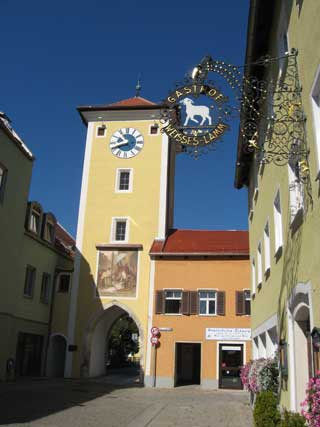
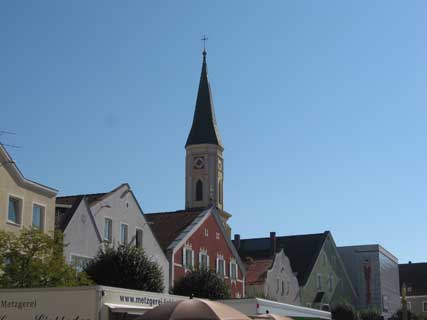
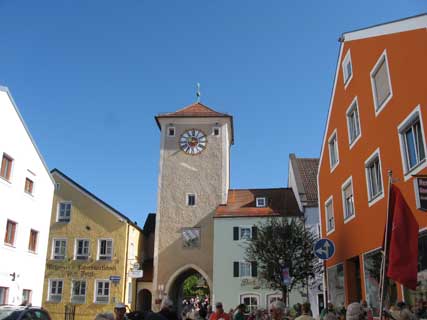
The visit was fairly quick and uneventful. The town has three gate towers, West, North and East with the Danube to the South. During our free time, Rob and I walked the width of the town to the Danube shore, which was crowded with tourist buses, trains and boats!
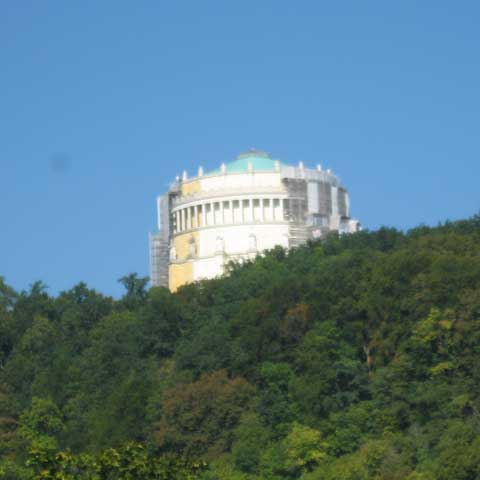
Up in the hills above the town, we could see the Befreiungshalle – The Hall of Liberation–commissioned by Ludwig I to celebrate German victories against Napoleon. This neoclassic building is perched proudly atop Mount Michelsberg and is undergoing renovation including an exterior cleaning that is restoring it to its original white color.
After our free time, the entire ship’s compliment of guests regrouped and went for an early morning beer tasting (and pretzel) at the Weisses Brauhaus Beirgarten. An Early Beer Break is a time-honored Bavarian tradition..and one we would do well adopting in the States!
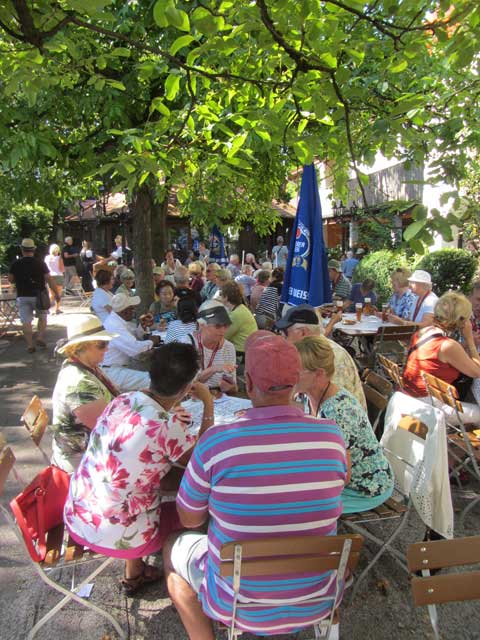
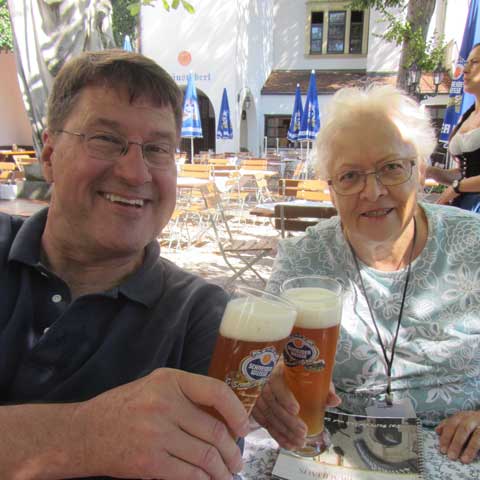
Good wheat beer–Rob & I each had two–and the pretzel was, well, Bavarian and thus of equally high quality. Then back to the boat for lunch and launch.
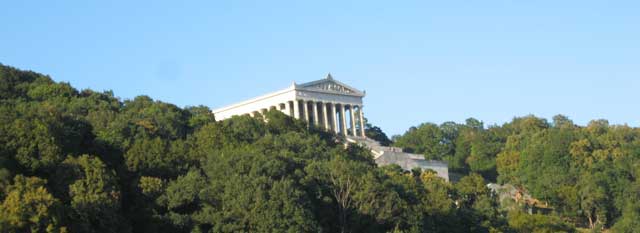
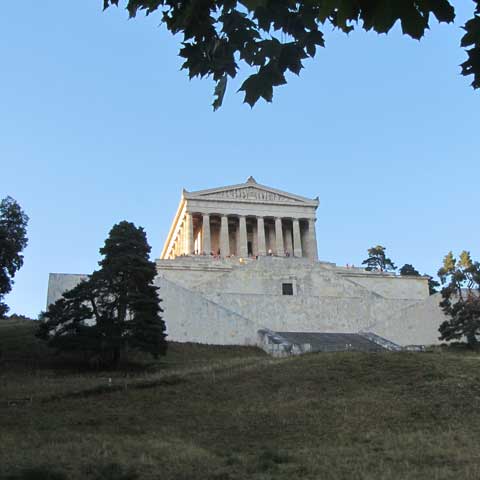
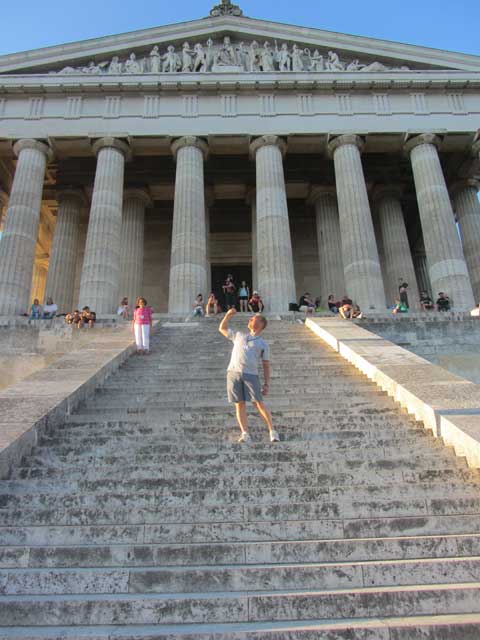
Here, a small but appreciated change was made to our itinerary. Originally scheduled to simply sail on to our next destination, our Program Directors worked in a little surprise stop. The boat docked at Walhalla–The Hall of the Slain–another of the Ludwig I’s memorials to all things German. This one, perched atop a hill as well, is patterned after the Parthenon in Athens. A dozen passengers–Rob included–made the climb to the top and back in the 45 minutes allotted. (420 steps, MDR!) He took some great pictures up there.
We passed under a lot of very cool bridges on this journey. We sailed under two of the most interesting ones today.
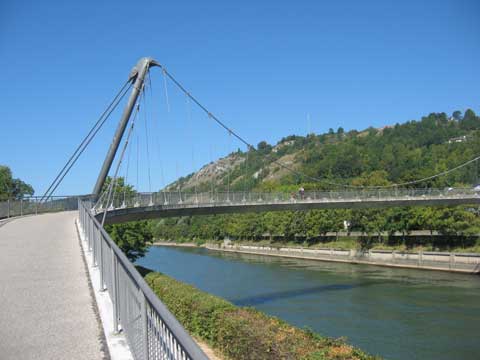
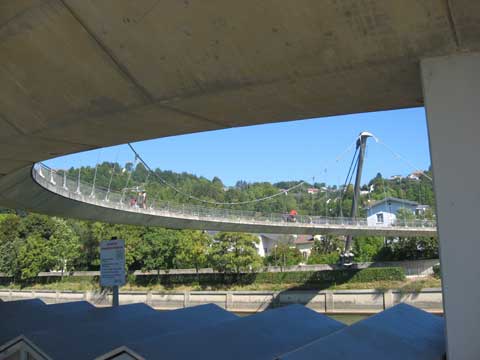
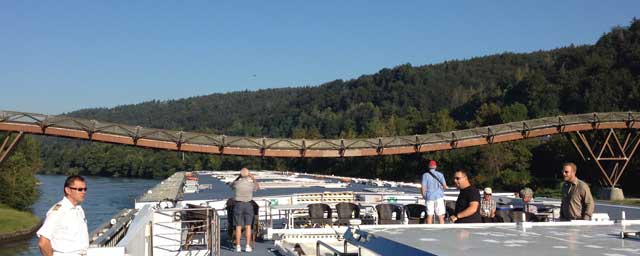
Notice the roof of the wheel house in the lower right-hand corner of the photo. The entire room was structured into two parts: a lower half and an upper half. When approaching a particularly low-hanging bridge, the lower half of the building would be hydraulically lowered into the deck while the top half would collapse down and over the lower half to further reduce the draft height. There was a hatch on top to allow the captain to see the boat’s progress. The cabin door was a dutch door allowing it to be opened when the cabin was compacted.
 Dutch to Deutsch: The Great Rivers of Europe